
Study abroad in Belgium
Visa, costs, healthcare and the best cities for exchange students in Belgium.
Capital
Brussels (Bruxelles / Brussel)
Languages
Dutch / French / German
Academic Year
Autumn semester: late September to late January (with January exam window). Spring semester: mid-February to early July (with June exam window and a September resit window). Christmas and Easter breaks observed.
Population
11,800,000
Typical Budget
EUR 850 - 1,300/month
Study Abroad in Belgium: What to Expect
Study abroad in Belgium works best if you want a compact country with serious universities and very different student cities. Brussels is international and administrative, Leuven is classic and campus-heavy, and Ghent is social, creative and easy to enjoy by bike.
Who loves this country?
Students who want strong universities, compact travel, multilingual daily life and EU-city access usually fit Belgium well.
What makes it special
Belgium combines Leuven's classic student city, Ghent's creative student rhythm and Brussels' EU/international ecosystem within short train distances.
Newcomer shocks
- Housing moves early in Brussels, Leuven and Ghent, and contracts can feel more formal than expected.
- Belgium is small, but language zones matter: Dutch, French and English do not work the same way everywhere.
- Train travel is excellent, but student discounts depend on age, operator and local rules.
- Rain and grey weeks are common, so indoor routines matter.
- Admin can be split between commune, university and health insurance, so keep documents organised.
Safety & Cost Indices
Source: Numbeo crowdsourced data. Lower crime = safer. Higher safety = safer.
Crime Index
Moderate
World avg: 44.7
Safety Index
Moderate
World avg: 55.3
Cost of Living
Expensive
EUR 850 - 1,300/month
Belgium is not the cheapest EU option, but student life is manageable when housing is solved early. Rent is the main pressure point; trains, canteens and student culture discounts are what make the monthly budget work.
Safety: Belgium is broadly safe with low violent crime. Pickpocketing in Brussels Midi/Centraal stations and around tourist sites is the main concern. Brussels neighbourhoods Molenbeek and Anderlecht warrant standard urban awareness at night.
Big Cities vs Small Towns
Big Cities
- Brussels is the de facto capital of Europe — proximity to EU institutions and NATO opens unique internship and networking opportunities unavailable anywhere else.
- Highly multilingual city (French, Dutch, English all function); adapts well to international students.
- Higher cost of living than other Belgian cities, but internship income from EU institutions is generous.
- Vibrant student nightlife (Ixelles neighbourhood) and cultural scene.
Small Towns
- Ghent and Leuven are classic student cities — compact, bike-friendly, overwhelmingly young populations, and strong university identities (Ghent University, KU Leuven).
- Bruges and Liège are smaller still, with lower rents and a more intimate community feel.
- In Leuven and Ghent, the university dominates city life — student culture is everywhere, not confined to a campus.
- Lower costs and higher social cohesion make smaller Belgian university cities ideal for deep integration.
Culture & student life in Belgium
Belgian student culture is multilingual, organised and more local than it first appears. Expect direct planning, separate language communities, strong beer and food traditions, and a social rhythm built through associations, kot life and city festivals.
Social Norms
Greetings: 'Bonjour' (French), 'Goedendag' / 'Hallo' (Dutch). Three cheek kisses in French Belgium between friends; a handshake elsewhere.
Punctuality matters: 5 minutes early for classes and meetings is standard.
Address professors as 'Professeur' / 'Professor' until invited to switch — academic hierarchy is moderately formal.
Tipping: not obligatory; rounding up or 5-10% for great service is appreciated. Service is included by law.
Beer culture is institutional — Belgium has 1,500+ beers and most cafés expect you to order one with each round, not nurse one for hours.
Sundays are quiet: most shops close, but restaurants, cafés, and museums stay open.
Daily Rhythm
Local pace07:30–09:00
Morning
Belgians are punctual. Breakfast at home: tartines (bread with butter and jam) and coffee. Bakeries open by 07:00 for fresh croissants and pistolets.
12:00–13:30
Midday
Lunch is a social event. Workers and students take a full break. Friteries (fry shops) and brasseries fill up. Business lunches run to 14:00.
14:00–18:00
Afternoon
Peak productivity hours. Coffee breaks are obligatory. Many shops open until 18:00 but close one half-day per week.
18:30–21:00
Evening
Dinner typically 19:00–20:00. Belgians eat well at home; dining out is reserved for weekends. Beer with dinner is entirely normal.
21:00–02:00
Night
Bars in Brussels and Ghent stay lively until 02:00–03:00. Club culture is strong in Brussels; Fuse and Kompass open late on weekends.
Food Culture

Frites with sauce (from a friterie)
EUR 3.50-6Belgian fries are a national institution. Order 'une grande' / 'een grote' with mayo, andalouse, or samourai.
Maison Antoine in Brussels and Frituur Tabora are late-night student staples — under EUR 5 for a full meal.

Carbonnade flamande
EUR 14-22Flemish beef stew slow-cooked in dark beer. Comes with frites or mashed potatoes. Best in a brown café.
University mensas and ESN dinners often serve carbonnade for EUR 6-9.

Mensa / restos universitaires
EUR 4-7All Belgian universities run subsidised cafeterias. KU Leuven Alma chain is the gold standard; ULB Resto and UGent Resto offer EUR 5 hot meals.
Top up the Alma card / ULB card at the start of the month — discounted prices apply automatically.

Belgian waffle (gaufre / wafel)
EUR 2-6Liège waffle is sweet and dense (street vendors EUR 2); Brussels waffle is light and rectangular (cafés EUR 4-6 with toppings).
Avoid Grand-Place tourist stands — Maison Dandoy and the friterie-style street kiosks are far better.

Moules-frites
EUR 15–25Steamed mussels served with a mountain of fries — one of Belgium's most iconic national dishes, especially popular in Brussels and along the coast.
Look for moules-frites deals in September when the mussel season opens and prices drop.

Belgian chocolate
EUR 1–5Belgian pralines and filled chocolates are world-famous. Neuhaus, Godiva, and Leonidas are premium brands; supermarket chocolate is also excellent quality.
Leonidas shops offer the best quality-to-price ratio for gifting; local supermarket brands like Côte d'Or are excellent for daily treats.
Cultural dos & don'ts in Belgium
Do
Greet shopkeepers and bus drivers ('Bonjour' / 'Goedendag') — silence is considered rude.
Validate (oblitere) train tickets if not using a Go Pass / Youth Pass — SNCB inspectors fine EUR 75+.
Apply for a Go Pass 1 (under-26, EUR 7.40 single intercity) or Youth Holidays Pass — pays itself in two weekends.
Sort waste rigorously: blue bag (PMC), yellow bag (paper), green (organic, in Flanders) — fines apply for wrong bag.
Take advantage of museum free Sundays — first Sunday of each month all federal museums are free.
Try to learn basic Dutch or French depending on your region — even a few words unlock significant goodwill.
Register with a mutuelle (CM, Solidaris, or Helan) within the first month — needed for health reimbursements.
Register at the commune within 8 working days of arrival — this unlocks banking, residence permit, and mutuelle.
Buy or rent a bike immediately if studying in Leuven or Ghent — it is the de-facto student transport.
Don't
Do not skip commune registration within 8 working days — affects your residence permit and bank account.
Do not assume French in Flanders or Dutch in Wallonia — language switching is locally sensitive; default to English if unsure.
Do not dump rubbish in non-compliant bags — fines EUR 50-150 are common in Brussels.
Do not jaywalk near schools and tram lines — police do issue EUR 58 fines.
Do not call Belgians 'Dutch' or 'French' — Belgian identity is distinct.
Do not buy intercity train tickets onboard without warning the conductor first — the surcharge is EUR 9 and inspectors are strict.
Do not leave housing until the last moment — Brussels and Leuven have tight rental markets that move fast.
Do not pay rent deposits in cash without a written receipt — use bank transfer and keep all documentation.
Do not assume student bars run cheap transport home — plan night bus routes (Noctis) before going out.
Things to do in Belgium as a student
The lifestyle advantage is proximity: you can study in Leuven, visit Brussels for institutions, and spend weekends in Ghent, Antwerp, Bruges or the coast. The trade-off is grey weather and housing competition in the best areas.

Bruges canal boat tour
UNESCO medieval city. Canal boat tours EUR 12. Student Interrail or Go-Pass train tickets make it cheap from any Belgian city.
Learn more
Belgian beer tasting
Belgium has 1,500+ certified beers including UNESCO-recognised Trappist ales. Delirium Tremens is EUR 3-5 per glass. Visit a real abbey brewery like Chimay or Orval.
Learn more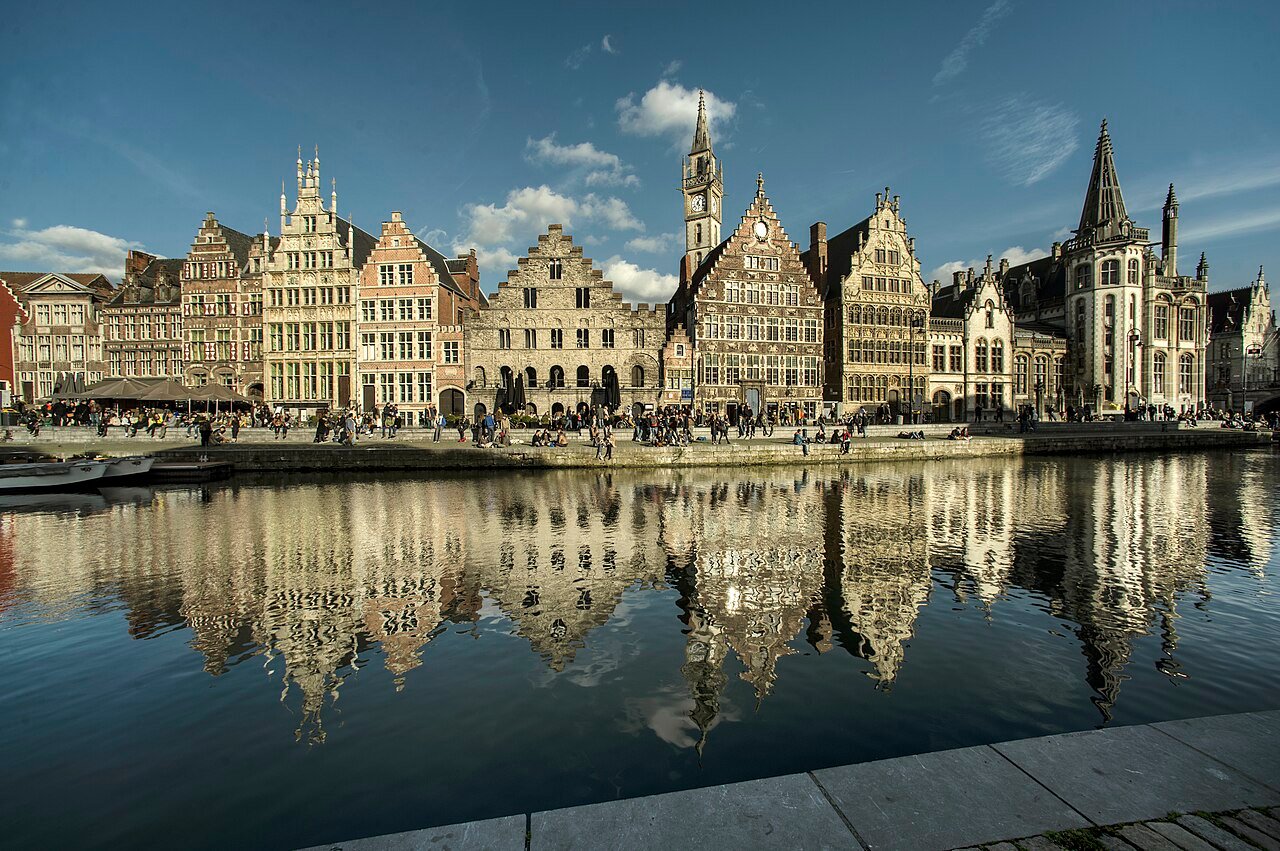
Ghent waterfront walk
Free walking tour of one of Europe best-preserved medieval city centres. Ghent is quieter and cheaper than Bruges but equally beautiful.
Learn more
Brussels comic book trail
Belgium is the birthplace of Tintin and the Smurfs. Free self-guided walking trail following 50+ giant comic strip murals painted on building facades.
Learn more
Ardennes hiking & kayaking
Kayak the Ourthe or Lesse rivers (EUR 15-25 half day). Belgian Ardennes has well-marked hiking trails through forest and past medieval castles.
Learn more
Antwerp fashion quarter
Antwerp is a global fashion capital with the Royal Academy of Fine Arts. Vintage shops, independent designers, and MoMu fashion museum (EUR 12).
Learn more
Chocolate workshop
Belgium produces the finest pralines in the world. 2h workshops from EUR 25 where you make and take home your own chocolates. Top student activity.
Learn more
Ypres war memorial visit
Free Last Post ceremony every evening at the Menin Gate since 1928. WWI battlefields and cemeteries around the city. Sobering and deeply moving.
Learn moreFestival Calendar
 Lively
Two weekends in late July
Tomorrowland
Boom (between Brussels and Antwerp)
The world's most elaborate electronic music festival. Tickets sell out in minutes — set a calendar reminder for the presale. Day passes EUR 130, weekend tickets much more.
 Lively
10 days in mid-July
Ghent Festival (Gentse Feesten)
Ghent city centre
The largest free urban festival in Europe: 200+ stages, street theatre, music, and food stalls for 10 consecutive days. Sleep little, eat a lot, spend almost nothing.
 Relaxed
Three days before Ash Wednesday
Carnival of Binche (UNESCO)
Binche, Wallonia
UNESCO-listed carnival with the iconic Gilles dancers in wax-orange-throwing costumes. Free entry, accessible by direct train from Brussels for EUR 8 return.
 Active
Last weekend of May
Brussels Jazz Weekend
Brussels (Grand-Place, Sablon, multiple venues)
Over 200 free concerts across the entire city over a single weekend. The Grand-Place stage is spectacular; the Sablon wine bars turn into jazz venues until midnight.
 Active
July 21
Belgian National Day (Fête Nationale)
Brussels
Military parade in the morning, free concerts in Parc de Bruxelles in the evening, and spectacular fireworks over the royal palace at midnight. Entire city is free and festive.
Travel Tips
- SNCB Go Pass 10 (EUR 59, under 26): 10 single intercity trips anywhere in Belgium. Best deal for any Erasmus student.
- Brussels-Paris (Thalys/Eurostar) in 1h22, Brussels-Amsterdam in 1h53, Brussels-London (Eurostar) in 1h55 — book 2 months ahead from EUR 35.
- FlixBus and BlaBlaCar Bus cover routes to Germany, France, NL from EUR 5-12.
- Charleroi airport (Brussels-South) is a Ryanair hub — flights to Spain, Italy, Greece from EUR 25 return.
- De Lijn (Flanders bus/tram) and STIB-MIVB (Brussels) integrate with student passes — Buzzy Pazz EUR 232/year for under-25s in Flanders gives unlimited bus/tram.
Scholarships & student benefits in Belgium
Student benefits are practical rather than dramatic: rail youth fares, local transit passes, university restaurants, museum pricing and Erasmus or regional scholarships. The savings only help if you check the rules by city and operator.
Useful either way
Support and discounts that still matter even if you are not in a strict incoming or outgoing case.
SNCB Go Pass 1 / Youth Holidays Pass
Under-26s get single intercity tickets for EUR 7.40 (Go Pass 1) anywhere in Belgium, or a Youth Holidays Pass (EUR 25 for 10 single trips during school holidays). Massive savings on weekend travel.
SNCB / NMBS (Belgian Railways)
Official sourceErasmus+ EU Mobility Grant
Incoming Erasmus+ students may receive a monthly grant from their home institution; the amount depends on home country, mobility type and university rules.
European Commission via home university
Official sourceMaster Mind Scholarships (Flemish government)
Highly competitive scholarships for top non-EEA students entering English-taught masters at Flemish universities. EUR 9,200/year living allowance plus full tuition waiver and insurance.
Flanders Department of Education and Training
Official sourceARES scholarships (Wallonia-Brussels)
ARES grants for students from developing countries pursuing masters in French-speaking Belgian universities — EUR 1,200/month plus tuition and travel.
ARES (Academie de recherche et d'enseignement superieur)
Official sourceBelgium student visa requirements
Difficulty: EasyEU/EEA students have a simple route, but registration and health insurance still matter. Non-EU students should treat visa, residence card, blocked funds or proof of means, and commune appointments as one deadline-driven workflow.
National ID card or passport
EU/EEA/Swiss students do not need a visa. Within 8 working days of arrival, register at the commune (gemeente/maison communale) of residence to obtain an Annex 8 (declaration of arrival) and start the procedure for a residence document (E-card) if staying more than 90 days.
Type D student visa (Long Stay) — 'ASP' visa
Non-EU students apply for a Type D student visa at the Belgian embassy in their home country before travel. Required documents: university acceptance letter, proof of EUR 803/month financial means (Annex 32 sponsorship or blocked account), valid health insurance, criminal record certificate (apostilled), medical certificate. Processing 4-12 weeks. Visa fee EUR 211. Allows up to 20h/week of work during semester.
Application Checklist
9 steps-
1
Confirm visa requirement: EU/EEA/CH = none; non-EU = Type D student visa.
-
2
Obtain official admission letter from the Belgian host university (Erasmus learning agreement signed by both institutions).
-
3
Prepare financial proof: EUR 803/month for the full stay (parental sponsorship via Annex 32, scholarship letter, or blocked bank account at a Belgian bank).
-
4
Secure accommodation contract before arrival — required for commune registration.
-
5
Apply for Type D visa at Belgian consulate at least 8 weeks before travel; bring legalised criminal record and medical certificate.
-
6
On arrival, register at the commune within 8 working days; receive Annex 8 (declaration of arrival).
-
7
Open a Belgian bank account (KBC, BNP Paribas Fortis, Belfius, ING) for rent, mutuelle, and university fees.
-
8
Register with a mutuelle (health insurance fund) — CM, Solidaris, or Helan — within the first month.
-
9
Enrol officially at the university and obtain student card; pay tuition (EUR 906-979/year for EU regulated).
Regional Variations
Flanders (Vlaanderen)
Public university tuition is the same as the federal regulated rate but Flemish universities deliver the largest English-taught master catalogue in Belgium. Communal registration in Flemish cities is in Dutch — bring a Dutch-speaking helper or use the international office.
Some communes require proof of insurance hospitalisation as part of registration.
Same federal mutuelle system; CM and Solidaris dominate.
Brussels-Capital Region
Bilingual region: communes operate in French or Dutch (Ixelles is French; Schaerbeek is bilingual). Most communes have an English service desk for international newcomers.
No additional document.
Same federal system; Brussels has the largest network of multilingual GPs.
Healthcare for international students in Belgium
How It Works
Belgium operates a compulsory health insurance system through 'mutuelles' (mutualités / ziekenfondsen). All residents — including non-EU students staying more than 3 months — must register with a mutuelle of their choice: CM (Christelijke Mutualiteit), Solidaris, Helan, or Partenamut. Patients pay upfront at the GP and are reimbursed 75-100% by the mutuelle within 2-4 weeks. EU students with a valid EHIC can use public services at standard Belgian reimbursement rates without registering with a mutuelle.
Student Needs
Non-EU students: register with a mutuelle within the first month of arrival — annual contribution is approximately EUR 65-130/year depending on the provider. EU students: present EHIC at GP and hospital for immediate coverage; for stays over 90 days, registering voluntarily with a mutuelle provides faster and fuller reimbursement. To see a GP (généraliste / huisarts), walk in or book by phone — consultation costs EUR 25-30 with EUR 19-23 reimbursed. Always ask for a feuillet de soins (care record) for your mutuelle claim.
Emergency vs Clinic
Call 112 for any emergency or 100 specifically for fire/ambulance. Public hospital emergency rooms (urgences / spoed) treat all patients regardless of insurance status — billing and reimbursement happen after treatment. For non-urgent evening or weekend care, call the medical on-call line (médecin de garde / wachtdienst) via your mutuelle or local healthcare authority before going to A&E.
Public Coverage Notes
Mutuelle covers 75-100% of GP and specialist visits, hospitalisation, and most medication at standard INAMI/RIZIV tariffs.
Hospitalisation insurance (assurance hospitalisation, ~EUR 10-30/month extra via DKV, AG Insurance, or similar) is strongly recommended — it covers single room supplements and out-of-tariff charges.
EHIC: EU students get full medically necessary care at Belgian rates. Long-stay EU students should still register with a mutuelle for continuity and faster reimbursements.
Best cities to study in Belgium
Compare cities before choosing: Brussels gives EU networks and big-city complexity, Leuven gives the densest student rhythm, and Ghent gives a creative city with strong research and nightlife.

Brussels
EU institutional capital and Belgium's most international city: ULB, VUB, and KU Leuven Brussels deliver the country's deepest English-taught master catalogue, 35%…
Open City Guide
Leuven
The textbook student town: 60,000+ students in a city of 100,000, KU Leuven (Belgium's #1 university, founded 1425), and 25 minutes by…
Open City Guide
Ghent
Belgium's most underrated student city: 75,000 students, Ghent University in the QS top 150, a medieval canal-laced centre that goes fully car-free,…
Open City Guide